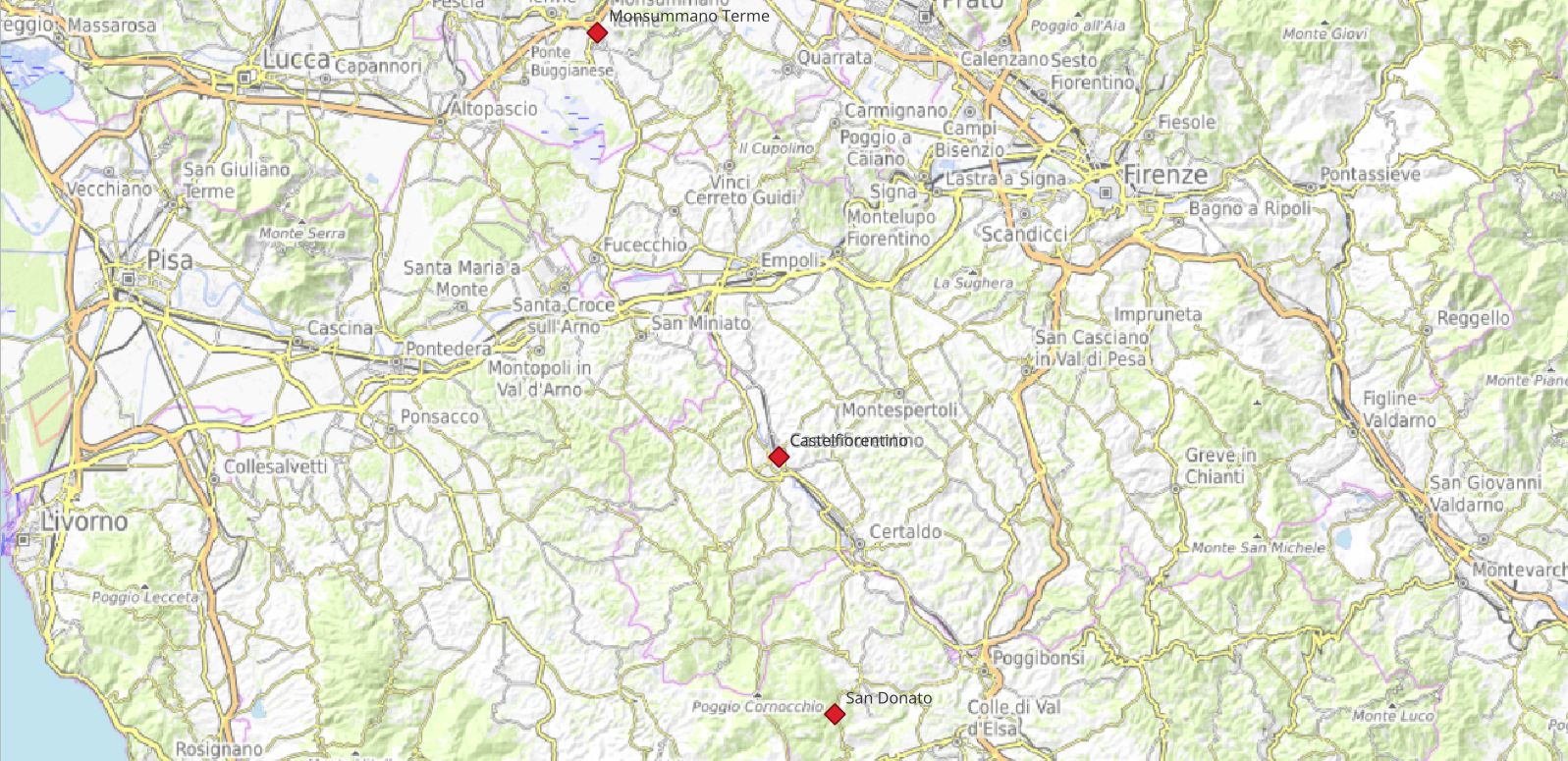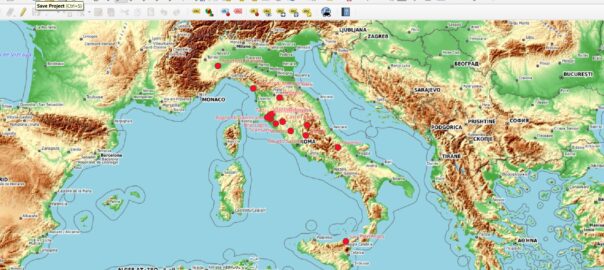
While Jefferson the punk emu and Mauro Tirannosauro where on a musical rampage (see video from last Friday), Guimarães, Jefferson’s Brazilian cousin, with the pibinko.org think-tank refreshed a topic we have been following for some time…possibly since forever (in fact, pibinko was not born in Italy)…”foreign people” in Italy. To start with: what is the percentage of non-Italians at the municipality level?
As reference data we considered the set from ISTAT (the Italian statistics office) for 2025. The national average is around 11.7% …but we like to see a bit more in detail. Below you also fine the distribution histogram. To make a long story short, yellow and green are places which are a little below or a little above the average. Red, orange, and blue are stronger differences. At the extremes we find: Campione d’Italia (which is a bit of an outlier, since it is a sort of exclave in Switzerland), with almost 60% of “alien residents”, and five municipalities with no foreigners at all.
Let us also remember that administrative boundaries are not necessarily representative of territorial dynamics; nevertheless the municipality-level data are the easiest to retrieve. Also…the eye will detect directly interesting “clusters”. E.g. we immediately noted the blue and green patch in Southern Tuscany (where we are based) …until the next map….arrivederci!
We are pleased to announce that we have registered three domains as access points for news that we publish with the “pibnet“, in relation to our “home base”:
At this stage the three sites are a plain redirect to pages in mappare.org, which in turn combine the interactive masp from our atlas with other posts in the network. If you like the idea and you would like to collaborate, we can improve it.
We are pleased provide a and abridged translation of the press released issued last week about the SA.MU.R.A.I. project. With the pibinko.org network, in addition to being part of the project proposal team, and creating the acronym, we are providing support to the management of the project. Also, we have proposed the “off-residency” concept, in which we will be proposing also some of our historical initiatives. Stay tuned! -The project web site is: https://www.samurai-rmt.it
March 16, 2026, Ponsacco (Pisa) – SA.MU.R.A.I., the free musical training and residency program is starting to roll. Following the open call, which saw the application by 68 young artists between 18 and 35, residing in Tuscany, and the subsequent online and in-person selection phases, on March 16 the residency had its official opening, with fifteen students involved, from all Tuscan provinces. The selection was meant for individual musicians, and not for existing bands. This choice will encourage the cross-over of different artistic paths and the development of new collaborations. In fact, the participants will get to know each other during the residencty, living and working together in the Camugliano Estate, a historical venue in the county, in the municipality of Ponsacco, about 30 minutes south-east from Pisa. The project will proceed through December, helping the participants to develop ther artistic and professional profiles. The artits will be coached by a team of senior experts, chosen to combine a high-level musical training with a hands-on approach to working in the musical sector today.
The director is Matteo Zanobini, founder of Picicca Management, an Italian company operating in the management and promotion of independent music, and reknown for the quality of its projects, including above all Brunori SAS and Lucio Corsi. The fifty training days represent the core of the residency, with activities focused on the development of professional and artistic skills. There will be a first phase between March 16 and May 22, with weekly sessions. After the Summer break, the residency will resume from Sep. 28 and Oct. 9, and then from November 16 to November 20. The experience will end with a concert at the PARC in Florence in December.
Next to the training, there will be an interdisciplinary and cross-cutting program of activities. This has been conceived to extend the training beyond the boundaries of the estate (and of the musical sector), and to create a liaison with cultural and professional activities in a wider territory.
The Samurai project was created by a partnership composed by Salty Music APS and Toscana Produzione Musica, two subjects with a wide experience in the design and management of cultural projects, in training, and in live music. SA.MU.R.A.I. is funded by Regione Toscana as a part of PR FSE+ Toscana 2021–2027 and is one of the musical residencies supported by Giovanisì.
In the context of the uni*rural* 2025-2026 program, and on our line of documentation since 2007 of lesser-known aspects, in particular in rural areas, we are inviting you to take part in a survey which focuses from looking for “stuff” to folks who are documenting stuff: we are looking for documentary makers and directors, with their works in rural/marginal areas. We are adding to the survey a prize which, possibly in the wake of the recent Academy Awards we would like to assign to the “best non-supporting tractor”.
If you are in a hurry and you know somebody who made a movie or a documentary on a lesser-known location, please write to segreteria@unirural.org or +393317539228. If you have ten minutes please read on. We also recommend, on the same topic, the TV9 interview on Nov. 18 on the first “Jug Film Festival per le Colline Metallifere” (click here). This was considered interesting by the audience due to the presence of Mauro Tirannosauro and Jefferson the punk emu.
Where does this start from?
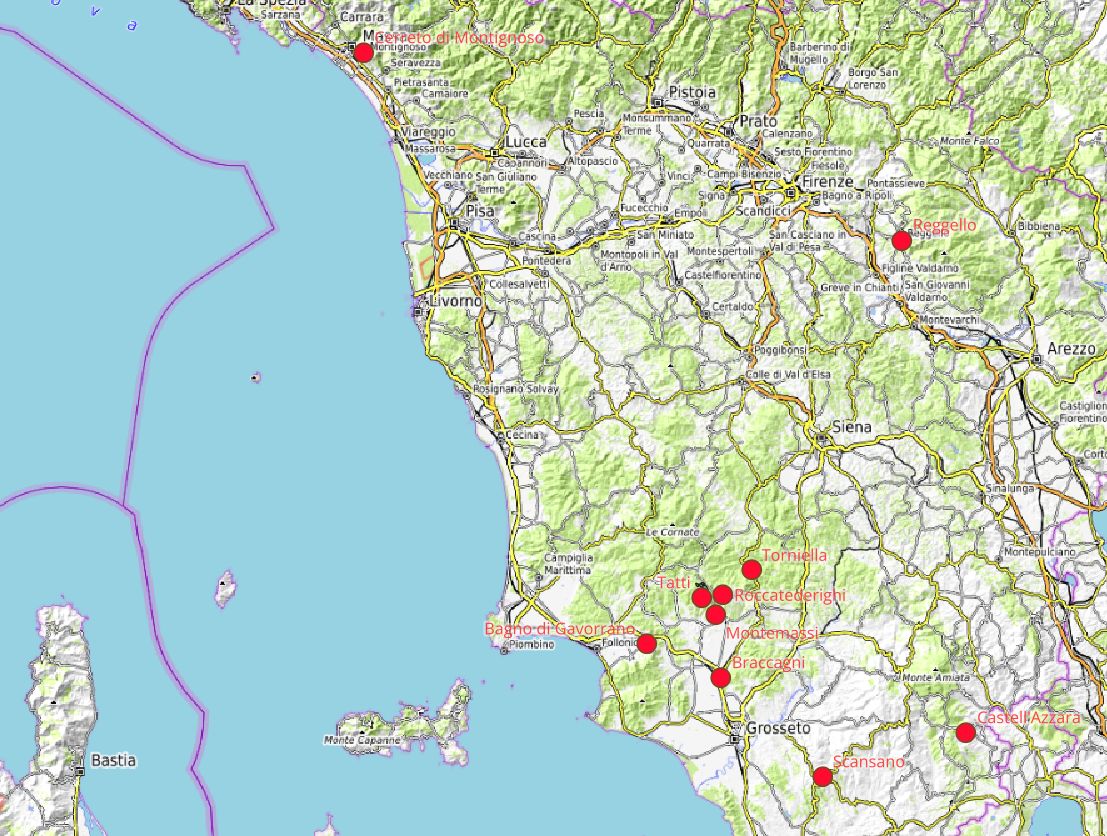
The idea for the survey spawns from the case of Tatti, Southern Tuscany, 209 residents, close to Massa Marittima, circa 100 km South of Florence, and 200 km North or Rome. Over a period of five years, we have noted at least four documentaries: 2021, Carlo Simeoni – Volere è Podere, 2023 Le api di Tatti, by Federico Santini, 2025 Ruedi Gerber, Tatti, paese dei sognatori (Tatti, the village of dreamers), 2026 – Susan Gluth – “Wenn Toskana-Auswanderer älter werden” (“When expats in Tuscany get old”).
These projects had different types of development and distribution, but all have in common the idea of telling the story of a small village and its people.
For the residents in the area, the fact of their village receiving such a level of attention is associated to the uniqueness of their place. The film coverage also gives a sort of “moral support” for communities living not in the most troubled parts of Italy, but with a number of open issues in terms of availability of services and resources to support a community.
But…how unique is this uniqueness? Since we monitor our main area of operation (Maremma and the Metalliferous Hills, around one quarter of Tuscany), we see that there are periodically video reports and documentaries in other locations…are they peculiar but less unique? Or…if a community lives in a place which has no documentaries about it, will it have less value? Furthermore, in the development of a marginal community, is it better to be featured in a documentary, to become the location for non-tourist productive facilities, or to be the home village for a Nobel prize? We need to see what is around…
(Three random cats. They are unrelated to the topic, but they improve the positioning of this article in the meta-verse)
Do you know of a feature film or a documentary about a lesser-known/marginal place?
If you live in such an area, and you have produced a documentary, or a film, about your place, or you know somebody who did this, please write to segreteria@unirural.org or +39 3317539228.
Concerning the definition of “lesser known” or “marginal”: we do not intend to draw a hard line on e.g. the number of residents, or refer to parameters used in studies etc, since this might end up excluding interesting works. We are in any case considering villages, valleys, bays, etc.. places with a geographic identity.
We would like to learn about these projects and provide visibility to them through our network. As for other “surveys” we will have a map and some articles (https://www.mappare.org/atlante/).
All responses will be advertised and could become part of collaborations, events, reviews, and more initiatives within the uni*rural* 2025/2026…we will see!
Duration of the survey and awards/mentions
There is time to submit your entries. We aim to present the results around mid-December. If you can send your entries by mid-September we have time to organize the presentation, and possibly assign prizes and mentions (if you would like to become a sponsor: segreteria@unirural.org or +393317539228).
For the moment we are considering the “Best Supporting Tractor” role, and other categories relating to rural aspects of life.
Selection Criteria
If we were to define these a priori, we will be in falling in the trap of “perceived objectiveness” of a documentary. Please send your entries, then we will have a look. As for our participatory civic works atlas (https://www.mappare.org/aplc, launched in August 2025), it will be interesting to consider two extremes, which sometimes blend. On one side we expect works produced with “local blood, sweat, and tears”, and no film commissions. On the other side we expect works which are conceived away from the places they portray.
We are aware of cases where the director and all of the production team is born and raised in a village, and other cases where the “driving force” of the prodution is not local. This have a very different impact on the audience, and on the territories. Say…: I came on vacation from Scandinavia to Poggio Marcellone close to Ratanzano, in the heart of Campania and I saw the sun for the first time in 43 years. I had 12 milion euro left over from a patent deal with some DotCom folks, so I made a documentary with a soundtrack by Randy van der Knaufen. He is the first violin in the Rantzburg symphonic orchestra. So Poggio Marcellone is nicer than Rocca Frandaglia which is 6 km away. And the sunset is better.
At the end of the day, we are not expecting this modus operandi to change. We do not even want to say what is better. We would just like to contribute to give a little more visibility to projects which have less visibility opportunities, but maybe work with the same spirit of those who have more of exposure.
With the pibinko.org network we have produced many short movies and interviews, so we have a lot of footage https://www.pibinko.org/videos/…to date, the most structured documentary we made is the story of 20 folks from three villages who went to Chicago to play their ancient games- https://www.pibinko.org/palla-21-a-chicago-e-ritorno-trailer/. So… we still miss our own contribution to a really local project. Let’s see if 2027 bring new material for our video manifesto…
As we prepare the uni*rural* presence in Murci (Southern Tuscany) for the Piccola Fiera del libro/Buchmesse (March 29, 2026), we have started to select and tidy up (er…tidying up is maybe an overstatement) a few items to bring. At the fair the the pibinko.org network will be represented by Jack O’Malley and Wolfgang Scheibe aka Tattistampa. They will be there both with their book lover/authoring hats and with their entertainer hats.
To tune in with the event, we also considered the idea of preparing some graphic design combining the “Jug” paradigm, which we started to use in 2018 for music (http://www.jugbandcm.it), and then extended to other initiatives (such as “trading” in 2023 our film festival, ecc). So: here we are with the “Jug Library dalle Colline Metallifere“…our network’s “distributed library”).
To start with, this is drawing mostly from the “reading” section of Stuff-o-teque (https://www.pibinko.org/stuff-o-teque/), but we are planning also to embed contributions from other colleagues…stay tuned.
If you are interested to share items with the JLCM (this does not mean that you have to physically give them to us, but at least we need to add them to our catalog)…books, magazines, maps, and other stuff which involves reading, please write to segreteria@unirural.org or 3317539228.
This one is for those who struggle as residents in amenity destinations. The first two stanzas were written sometime around 2022, and the rest was developed more recently.
The lyrics further elaborate on why people go places, on the relationships between “norths” and “souths”, etc. In this case we deal with German-speaking tourists, but we can apply the same to folks from other northern-language areas (and, always, without generalizing). The lyrics work on the base of a very “mean” Nineties tune. For more lyrics and songs on the same topic:
Chords: Ab, F, G, Cm (they never stop), and you have the video below to give you the groove. For more information, comments, details, and booking: micalosapevo@pibinko.org or +393317539228
German Pàradàis
Sono un tedesco | sono nato in germania – I am a German guy I was born in Germany
e da quando ho 12 anni | di viaggiare a sud ho smania – And since I was 12 I craved to travel South
ho girato per la Spagna | ho girato la Croazia – I’ve been wandering in Spain, I’ve been wandering in Croatia
ma è solo qui in Toscana | che il mio spirito si sazia – But it is only in Tuscany that my spirit is satiated
si sazia di tortelli | di paesaggi ed aria fresca – it gets satiated by “tortelli”, landscapes and fresh air
e non vado mai a caccia | ogni tanto forse a pesca – and I never go hunting, occasionally I might go fishing
io non cerco troppa gente | sono un tipo riservato – and I don’t go looking for too many people, I am a reserved type
spesso compro vecchie case | in un villaggio abbandonato – I often buy houses in abandoned hamlets
con l’estate si viene sai | a visitare il German Paradise – In the Summer we come you know, to visit the German Paradise
con la bici a ruote grosse | a me piace pedalare – I like to cycle with my bike with big wheels
ma se non sto molto attento | rischio poi di rotolare – but if I am not careful I might by rolling down
giù da un poggio o da un crinale | tutti posti molto ganzi – down from a hill or a ridge, all very cool places
dove spesso va il turista | alternando cene e pranzi – where tourists often go, between dinners and lunches
non pensando ad operai | contadini e muratori – not considering workers, farmers and builders
che mentre lui pedala | sono presi dai lavori – who, while he is pedaling are busy on their jobs
I lavori da cui lui | ha preso una vacanza – the jobs from which he took a break
e mentre sta in Toscana | vede il cielo in una stanza – and while he is in Tuscany, he sees “the sky in his room”**
con l’estate si viene sai | a visitare il German Paradise
Ho dipinto questo quadro | ma non devo criticare – I painted this picture , but I don’t mean to criticize
il grande indotto commerciale | lo sviluppo immobiliare – the great business revenue, the real estate development
garantito dal turista | quando vien dal settentrione – guaranteed by the tourist when he comes from the North
con i grandi portafogli | che ci lascia la pensione – with his big wallets he leaves his retirement pension here
derivata dai mestieri | degli stati protestanti – deriving from jobs in the protestant states
mentre noi si sta col Papa | la Madonna e tutti i santi – while we are here with the Pope, Mary and all the saints
a curare tutto l’anno | questo caro territorio – taking care all year long of our dear territory
che lui visita col sole | ma d’inverno è un po’ un mortorio – which he visits when it’s sunny, while in the winter it’s not very lively
With January’s waning moon here we go with the next BuioMetria Partecipativa (participatory night sky monitoring), campaign, turning 18 on June 9.
With the coming of age of our project we will be conducting, together with those who want to join, measurements of night sky quality with the “buiometro” (dark-sky meter), and other observations to better understand how light pollution works, how it can be reduced (without worsening our lifestyle), and how to use light in a more aware way.
The activities for this year are part of the course on “Nightscapes and dayscapes (link in Italian) by uni*rural*. This is the non-formal education program by the pibinko.org network, in collaboration with various partners. Active participants will be receiving educational credits which in some cases may be “spent” with your education institutions.
To start building our new team in the past months we have already contacted some wannabee “buiometristas”, especially in the southwestern quadrant of Tuscany (Pisa, Leghron, Grosseto). Then as you know, with the pibinko.org network we are open to contacts from any land, so please contact segreteria@unirural.org or +393317539228 if you are interested.
In February 2008, over a phone call between two environmental engineers about options for an amateur astronomer holiday in Southern Tuscany with a territorial marketing plan based on lesser-know aspects of the same region, the BuioMetria Partecipativa (or BMP) project was conceived.
At the time the project was the second globally (and the first in the western hemisphere) to propose lending to citizens sensors to conduct night sky quality measurements. Without initial external funding (and, in fact, never with a lot of external funding), the project initially had a significant media impact in Italy (RAI Radio 2, TG2 Costume e Società, Mickey Mouse magazine with a “Speciale Cacciatori di Buio” ecc.) and started to develop collaborations with numerous sectors of society (see this summary from 2017)
In the winter of 2010-2011 BMP promoted the creation of the first national coordination for the collection of light pollution data from fixed monitoring stations. This happened in collaboration with Veneto Stellato, Università di Roma Tre and various amateur astronomer associations. Namely, the BMP team, after launching the idea, took care of writing the code to handl the data harvesting from stations which were using different communications protocols, the aggregation of all monitoring data in a web database, and an online query/reporting interface. The system was active between 2011 and 2019 and in its peak phase was providing data from ten stations from different Italian regions.
The European dimension
Between 2013 and 2016 BMP also had a liaison role between Italian actors and European research on light pollution issues. Andrea Giacomelli was appointed as the primary point of contact for Italy in the “Loss of the Night” project in the COST research exchange program. In the same period formal collaborations were started with the University of Pisa and the National Research Council’s Institute of Biometeorology (now Bioeconomy) in Florence. Between 2016 and 2018 BMP also had collaborations with the Stars4all HORIZON project.
Awards and recognitions, in Italy and abroad
The first award recived by the BMP project was in 2009. This was for a national contest called “La Seconda Luna”, and BMP came in fourth out of 120 applicants, curiously with a prize for a category which did not exist in the contest rules. In 2015 the project was invitated for a presentation at the Eye on Earth conference in Abu Dhabi (where it turned out to be the only Italian project out of over 600 participants). In 2019 Andrea Giacomelli was awarded the title of “dark sky defender” by the International Dark Sky Association, for the dissemination and awareness work done in the previous ten years.
Apart from “serious” recognitions, BMP also had an impact which we may define “emotional”. For example, in 2020 a book of short stories about darkness “Il Buio” (Erasmo Libri) had a story inspired by the BMP project (and the story actually won a literature award).
BMP, regulations, and policy
BMP in time also had an active role in governance support (maybe this is not by accident, since one of the two founding engineers has also been part of the drafting team for a European Directive). In 2012 BMP sent eight comments to the revision of the Piano Ambientale ed Energetico della Regione Toscana (the Tuscan master plan on environment and energy). Five of these observations, including the one which led to declaring the night sky as a tourism resource, were accepted. Furthermore, the BMP experts have periodically been invited to provide advice on lighting and energy efficiency issues on various administration levels.
In 2018-19, following the “Capraia Night Sky” symposium (co-organizzato with UNIPI and CNR IBIMET), BMP proposed once again the idea of a coordinating body across various subjects involved in outreach, administration, and research. This did not go forward, but it would not be complicated to reboot the process.
Since 2020
The 2020 pandemic gave a severe blow to participatory activities: it would have been very difficult to run a project involving hand-to-hand instrument logistics. However, the core of the BMP engine was adapted to operate in strict lockdown mode, with the Participatory Lithology project, which also led Andrea Giacomelli to be invited to be an alumnus of the Robert Bosch Foundation.
In the past five years the BMP project has essentially operated as an “on-call” project, however our effort in weaving connections across subjects who ofter operate independently (but live, in any case, under the same sky) has not stopped. In particular, we have consolidated the use of music, in addition to photography, as a means to facilitate the dialogue among different parties, and always using maps as a minimum common denominator for analysis and communication. We also got to observe the Milky Way by day, as shown in the video below!
Educational credits
Over all this time, BMP also had a practical role in the educational field. We have covered primary, secondary, and high schools, universities (including lectures and tutoring for ERASMUS students), and professional charter organizations (architects, engineers, environmental guides). To learn more on how to acquire educational credit with the BMP project: segreteria@unirural.org or +393317539228
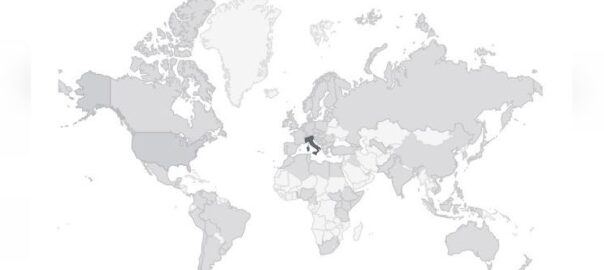
After publishing our “year in review” article (see link), in preparation for our upcoming initiatives we are giving you a few more statistics on our web presence. Here you can see as a list (or in the header image as a map) an overview of the countries from which somebody have seen at least once of our blog posts over the past twelve months, in alphabetical order:
If we extend the analysis to all of our logs (which start from 2019, even though the web site is on since 2006), to date in the world there are only a dozen countries from which our stories have not been seen.
Since the very first online moments of the pibinko.org network (the first web page written by pibinko is dated 1994, and the first site un pibinko activities was launched in 2006) we have proudly maintained our contents at leat in Italian and English (please note that on our sites we have around 6000 articles.
For our first tour in Germany with the JBCM we actually started a line of articles in German, with Wolfgang Scheibe providing the translations in addition to hand-made prints and one-string basslines. After the months we looked each other in the eye and said “Really?“.
Translating has never been a technical issue (pibinko also works as a translator and reviewer for international companies). However, with the launch of the uni*rural* (and after publishing a couple of months ago an announcement for translators) we start with the following line, considering the significant amount of material we expect to write:
We will be stopping the creation of the English versions of our articles (unless this is required by a customer or has a specific value for the network).
If you have issues reading our material in Italian, feel free to try your favourite translator (just reminding that, with the online ones there is a history of mistakes made on pibinko text))…
If, at any moment, your favourite translator will not suffice, we are available to provide clarifications and further information.
Otherwise, we will end up spending more time translating than doing the things we write about! Thank you for your understanding, and good luck with the improvement of your Italian on the pibinko.org sites! We will be re-assessing the case at the end of May 2026.
(**) Per la precisione bisogna escludere testi di canzoni di cui abbiamo curato la traduzione et similia, che comunque sono una quota trascurabile del totale
I am receiving around one e-mail per month, at least, with this subject. So the question is once more raised…why, as a professional and a researcher should I be interested to “preemptivee generation” of a random article from my scientific literature body of work?
In addition to not wanting this, and getting mildly irritated (but this is my fault), I also need to spend unwarranted time and energy to interrupt this sterile flow of information. Why? Because in order to do this I need to log in in my profile on this prestigious platform for the promotion of academic content, and toggle off an option which I never toggled on in the first place. In the meantime, people are suffering, and the ice caps are melting (o vice versa, you choose the order).
If you know of a valid reason for which, in a professional space, the preemptive generation of podcasts based on your original content makes sense, please let me know at micalosapevo@pibinko.org or +393317539228. I will be glad to buy you a drink the next time we meet.
p.s. clearly – is it worth to unsubscribe from the prestigious platform and then risk being told by fellow scientist “hey, are you not on ABCDEFGXXXX? come oooon” (choose your favourite accent)