First Results of the 2026 BuioMetria Partecipativa (Participatory Night Sky Monitoring) Observation Campaign

[PLEASE NOTE: For the moment we are publishing this article with no translation in English, so feel free to use your favourite translation aid, or to inquire with us if you need more details: segreteria@unirural.org or +393317539228. In any case, if you are interested in being part of the BMP team for this campaign, we do have instructions in English https://www.mappare.org/en/bmp-en/. For more explanations on the pibinko.org network update policies on translations, please this article].

Dopo le prime sei settimane dal lancio della campagna 2026 della Buiometria Partecipativa (9-1-2026), dopo tre dal lancio dell’app che ci serve per raccogliere le osservazioni (che – ricordiamo- possono essere fatte da grandi e piccini), e dopo il passaggio di lunedì scorso a Roma alla conferenza Mappe di Luce, cominciamo a condividere un po’ di risultati.

E’ prestissimo per trarre conclusioni sui dati raccolti, anche se -avendo iniziato a documentare la cosa nel 2008- un po’ il quadro ce lo abbiamo.

Come nelle feste, quando cominciano le danze ci vuole qualcuno che si butti e inizi ad animare la pista: ringraziamo intanto, nella dozzina di persone che si sono fatte vive manifestando interesse a partecipare dalla Puglia al Piemonte, quelli che hanno materialmente hanno cominciato a trasmettere dati: Angelo (Circolo Legambiente Costa Etrusca), Luciano (CNR IBE), Franco da Polveraia, Federico Giussani, il nostro storico fotografo di paesaggi notturni, e Carlo Madrini (entrambi attualmente in missione in Marocco), Pardo da Livorno. Ecco che cosa hanno combinato, insieme a pibinko (cliccando su un punto si apre una finestra con varie note di campo, oltre al link alla foto scattata sul posto…vedrete anche altri dati “di servizio” ma ricordiamo che l’applicazione e le interfacce sono in versione iniziale):

I rilievi eseguiti in questa fase sono utilissimi per mettere a punto il flusso di raccolta delle informazioni e alcune ipotesi di lavoro. Intanto ci hanno fatto trovare un sacco di luci “nobbùono” ma anche situazioni “bbùono”, come avrebbe detto Andy Luotto. Per il momento vi lasciamo licenza di “clic” e non dilunghiamo in spiegazione verbose, che possiamo dare a chi fosse interessato, vedi sotto per i contatti.

Si prosegue con le osservazioni, e se siete interessati a partecipare alla CBMP2026, trovate le istruzioni alla pagina: https://www.mappare.org/bmp/ (o https://www.mappare.org/en/bmp-en/ per i vostri amici che leggono meglio in inglese).

Ricordiamo che la CBMP2026

  • non è una gara (ma potete ricevere premi se partecipate)
  • non è un progetto che parte con un finanziamento esterno (ma potete sostenerla)
  • non ha direzione scientifica esterna (ma collabora dal 2009 con istituzioni di ricerca in tutto il mondo)

e inoltre che

  • Vi può dare crediti formativi (sia negli studi che nella professione), attraverso il programma uni*rural* (https://www.unirural.org)
  • Se partecipate in modo non estemporaneo, vi metterà in relazione con diversi personaggi interessanti e/o ganzi e vi farà ripensare al vostro rapporto con la luce (e magari illuminare meglio e risparmiare due lire di bolletta elettrica)
  • Il 9 giugno compie 18 anni come progetto, e stiamo organizzando la festa.

Per chi fosse curioso dei dati raccolti nel periodo 2008-2025

Eccovi la mappa interattiva “storica”. Mano a mano andremo a integrare i dati della campagna 2026 in quella generale.

Per informazioni e booking

segreteria@unirural.org o 3317539228

Sigla: Il cielo è di tutti

Rome, Feb. 23-2-26: Maps of Light: Geographic Explorations of the Sky and the Earth (also streaming, and featuring BuioMetria Partecipativa)

I am glad to share the program of a conference which will take place on Feb. 23, in Rome, at the Italian Geographic Society, and where our buiometria partecipativa project will be featured as the last talk, following experts from different disciplines.

The SGI is in Palazzetto Mattei in Villa Celimontana via della Navicella, 12 Rome (ph: +3906 7008279). It will be possible to follow the talks online at: https://teams.microsoft.com/meet/32506399255263?p=OvTMx8D46jwYIHicMG. The official language of the conference will be Italian.

Vi aspettiamo a Roma o in streaming, con tre link recenti

…e una piccola sigla (del maggio 2020):

Altre info: micalosapevo@pibinko.org o 3317539228

German “Pàradàis”

This one is for those who struggle as residents in amenity destinations. The first two stanzas were written sometime around 2022, and the rest was developed more recently.

The lyrics further elaborate on why people go places, on the relationships between “norths” and “souths”, etc. In this case we deal with German-speaking tourists, but we can apply the same to folks from other northern-language areas (and, always, without generalizing). The lyrics work on the base of a very “mean” Nineties tune. For more lyrics and songs on the same topic:

Chords: Ab, F, G, Cm (they never stop), and you have the video below to give you the groove. For more information, comments, details, and booking: micalosapevo@pibinko.org or +393317539228

German Pàradàis

Sono un tedesco | sono nato in germania – I am a German guy I was born in Germany

e da quando ho 12 anni | di viaggiare a sud ho smania – And since I was 12 I craved to travel South

ho girato per la Spagna | ho girato la Croazia – I’ve been wandering in Spain, I’ve been wandering in Croatia

ma è solo qui in Toscana | che il mio spirito si sazia – But it is only in Tuscany that my spirit is satiated

si sazia di tortelli | di paesaggi ed aria fresca – it gets satiated by “tortelli”, landscapes and fresh air

e non vado mai a caccia | ogni tanto forse a pesca – and I never go hunting, occasionally I might go fishing

io non cerco troppa gente | sono un tipo riservato – and I don’t go looking for too many people, I am a reserved type

spesso compro vecchie case | in un villaggio abbandonato – I often buy houses in abandoned hamlets

con l’estate si viene sai | a visitare il German Paradise – In the Summer we come you know, to visit the German Paradise

con la bici a ruote grosse | a me piace pedalare – I like to cycle with my bike with big wheels

ma se non sto molto attento | rischio poi di rotolare – but if I am not careful I might by rolling down

giù da un poggio o da un crinale | tutti posti molto ganzi – down from a hill or a ridge, all very cool places

dove spesso va il turista | alternando cene e pranzi – where tourists often go, between dinners and lunches

non pensando ad operai | contadini e muratori – not considering workers, farmers and builders

che mentre lui pedala | sono presi dai lavori – who, while he is pedaling are busy on their jobs

I lavori da cui lui | ha preso una vacanza – the jobs from which he took a break

e mentre sta in Toscana | vede il cielo in una stanza – and while he is in Tuscany, he sees “the sky in his room”**

con l’estate si viene sai | a visitare il German Paradise

Ho dipinto questo quadro | ma non devo criticare – I painted this picture , but I don’t mean to criticize

il grande indotto commerciale | lo sviluppo immobiliare – the great business revenue, the real estate development

garantito dal turista | quando vien dal settentrione – guaranteed by the tourist when he comes from the North

con i grandi portafogli | che ci lascia la pensione – with his big wallets he leaves his retirement pension here

derivata dai mestieri | degli stati protestanti – deriving from jobs in the protestant states

mentre noi si sta col Papa | la Madonna e tutti i santi – while we are here with the Pope, Mary and all the saints

a curare tutto l’anno | questo caro territorio – taking care all year long of our dear territory

che lui visita col sole | ma d’inverno è un po’ un mortorio – which he visits when it’s sunny, while in the winter it’s not very lively

(continua…) – (to be continued)

** Il cielo in una stanza is a citation from a famous Sixties love song (https://www.pibinko.org/cielo-in-una-stanza/):

Feb. 11, 2026 – BuioMetria Partecipativa Turns 18 and is Seeking Night-time Volunteers (Il Tirreno Grosseto edition)

Kudos to Sara Landi

SA.MU.R.A.I. Musical Residency in Tuscany – Open Call (deadline: Feb. 24).

This is a call for a 300-hour music residency in the heart of Tuscany, half way between Pisa and Volterra, with lessons starting in mid March and ending in December (pausing during the summer months) with a final event in Florence. The tutors are very high-level music professionals from the Italian musical scene.

The call is open also to non-Italian citizens, provided that they are residing in Tuscany and have a knowledge of Italian sufficient to interact with others, so: here you have a full presentation in Italian to start with:

Toscana Produzione Musica e Salty Music APS, riunite in SA.MU.R.A.I. RMT ATS, presentano la Residenza Musicale Toscana SA.MU.R.A.I., nata per selezionare e far crescere nuovi talenti.

Un progetto gratuito rivolto a giovani musicisti, cantanti e cantautori residenti o domiciliati in Toscana, tra i 18 e i 35 anni, in possesso di diploma di istruzione secondaria di secondo grado, disoccupati, inoccupati, inattivi e occupati che intendano avviare un’attività nel settore musicale.

Il percorso formativo, coordinato da Matteo Zanobini (manager musicale e fondatore di Picicca Management), unisce lezioni teoriche e attività pratiche, con un focus sull’applicazione: musica d’insieme, produzione artistica, sperimentazione e co-creazione.

Da marzo a dicembre il percorso prevede 50 giornate di attività formative, per un totale di 300 ore, seguite da docenti di primo piano, in sei aree formative: Artistica interpretativa, Musica d’insieme, Tecnica e produzione, Management e discografia, Comunicazione e promozione e Aspetti legali, amministrativi eorganizzativi. A queste si affianca il Fuori Residenza, composto da dieci giornate di attività trasversali, tra
cui un incontro con Dario Brunori, visite didattiche ai tour di Brunori SAS e Lucio Corsi, oltre a una fase di post-residenza. Il percorso si concluderà a dicembre con un evento finale aperto al pubblico, un concerto presso il PARC di Firenze.

Le attività formative si svolgeranno prevalentemente presso la Tenuta di Camugliano, tra i comuni di Ponsacco e Capannoli (PI), dove i partecipanti conviveranno insieme in un contesto naturale che favorirà la concentrazione e la creatività.

Sono aperte le selezioni online: le domande di iscrizione potranno essere presentate fino alle ore 12:00 del 24 febbraio 2026, attraverso il sito samurai-rmt.it. Il percorso è gratuito ed è prevista una borsa di residenza pari a 25 euro al giorno, per un totale di 1.250 euro per l’intero periodo.

I candidati selezionati saranno invitati a una selezione in presenza presso l’ExWide di Pisa nei giorni 4 e 5 marzo 2026.

Al termine di questa seconda fase, saranno individuati i 15 partecipanti, motivati a intraprendere il percorso, scelti, sulla base di capacità tecnicche, creatività, originalità e presenza scenica, da una giuria composta da Andrea Fornai – coordinatore artistico Salty Music APS, Salvatore Barbato – direttore artistico The Cage Theatre, Marina Mulopulos – vocal coach, cantante, Matteo Zanobini – esperto di management e discografia, Rossella Falco – esperta comunicazione e promozione, Daniela Di Tommaso – rappresentante ATS Samurai RMT, Francesco Mariotti – Rappresentante ATS Samurai RMT.

SA.MU.R.A.I. è finanziato dalla Regione Toscana nell’ambito del PR FSE+ Toscana 2021–2027 e rientra tra le Residenze Artistiche Musicali sostenute da Giovanisì, il progetto della Regione Toscana per l’autonomia dei giovani.

Per ulteriori informazioni visitare il sito samurai-rmt.it o scrivere a info@samurai-rmt.it.

BuioMetria Partecipativa 2026: Who goes first?

With January’s waning moon here we go with the next BuioMetria Partecipativa (participatory night sky monitoring), campaign, turning 18 on June 9.

With the coming of age of our project we will be conducting, together with those who want to join, measurements of night sky quality with the “buiometro” (dark-sky meter), and other observations to better understand how light pollution works, how it can be reduced (without worsening our lifestyle), and how to use light in a more aware way.

The activities for this year are part of the course on “Nightscapes and dayscapes (link in Italian) by uni*rural*. This is the non-formal education program by the pibinko.org network, in collaboration with various partners. Active participants will be receiving educational credits which in some cases may be “spent” with your education institutions.

To start building our new team in the past months we have already contacted some wannabee “buiometristas”, especially in the southwestern quadrant of Tuscany (Pisa, Leghron, Grosseto). Then as you know, with the pibinko.org network we are open to contacts from any land, so please contact segreteria@unirural.org or +393317539228 if you are interested.

For all the BMP “files”: https://www.pibinko.org/buiometria-partecipativa-2/ …but please see below for an educated summary.

A little bit of history

In February 2008, over a phone call between two environmental engineers about options for an amateur astronomer holiday in Southern Tuscany with a territorial marketing plan based on lesser-know aspects of the same region, the BuioMetria Partecipativa (or BMP) project was conceived.

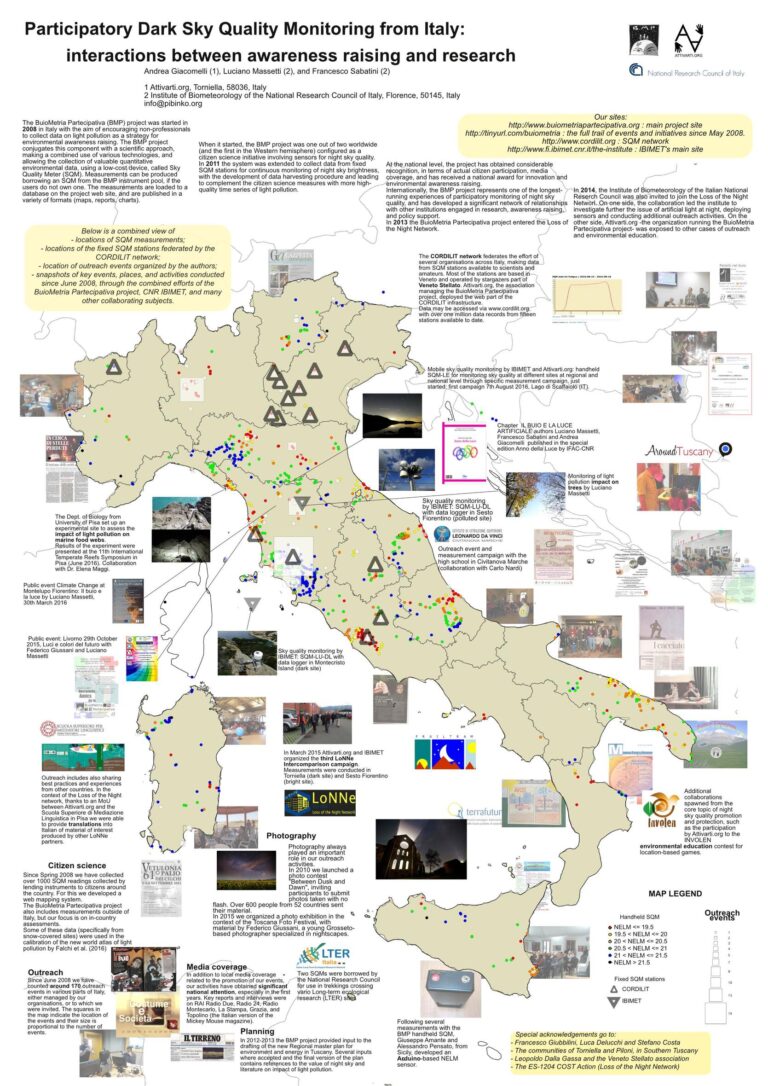
At the time the project was the second globally (and the first in the western hemisphere) to propose lending to citizens sensors to conduct night sky quality measurements. Without initial external funding (and, in fact, never with a lot of external funding), the project initially had a significant media impact in Italy (RAI Radio 2, TG2 Costume e Società, Mickey Mouse magazine with a “Speciale Cacciatori di Buio” ecc.) and started to develop collaborations with numerous sectors of society (see this summary from 2017)

In the winter of 2010-2011 BMP promoted the creation of the first national coordination for the collection of light pollution data from fixed monitoring stations. This happened in collaboration with Veneto Stellato, Università di Roma Tre and various amateur astronomer associations. Namely, the BMP team, after launching the idea, took care of writing the code to handl the data harvesting from stations which were using different communications protocols, the aggregation of all monitoring data in a web database, and an online query/reporting interface. The system was active between 2011 and 2019 and in its peak phase was providing data from ten stations from different Italian regions.

The European dimension

Between 2013 and 2016 BMP also had a liaison role between Italian actors and European research on light pollution issues. Andrea Giacomelli was appointed as the primary point of contact for Italy in the “Loss of the Night” project in the COST research exchange program. In the same period formal collaborations were started with the University of Pisa and the National Research Council’s Institute of Biometeorology (now Bioeconomy) in Florence. Between 2016 and 2018 BMP also had collaborations with the Stars4all HORIZON project.

Awards and recognitions, in Italy and abroad

The first award recived by the BMP project was in 2009. This was for a national contest called “La Seconda Luna”, and BMP came in fourth out of 120 applicants, curiously with a prize for a category which did not exist in the contest rules. In 2015 the project was invitated for a presentation at the Eye on Earth conference in Abu Dhabi (where it turned out to be the only Italian project out of over 600 participants). In 2019 Andrea Giacomelli was awarded the title of “dark sky defender” by the International Dark Sky Association, for the dissemination and awareness work done in the previous ten years.

Apart from “serious” recognitions, BMP also had an impact which we may define “emotional”. For example, in 2020 a book of short stories about darkness “Il Buio” (Erasmo Libri) had a story inspired by the BMP project (and the story actually won a literature award).

BMP, regulations, and policy

BMP in time also had an active role in governance support (maybe this is not by accident, since one of the two founding engineers has also been part of the drafting team for a European Directive). In 2012 BMP sent eight comments to the revision of the Piano Ambientale ed Energetico della Regione Toscana (the Tuscan master plan on environment and energy). Five of these observations, including the one which led to declaring the night sky as a tourism resource, were accepted. Furthermore, the BMP experts have periodically been invited to provide advice on lighting and energy efficiency issues on various administration levels.

In 2018-19, following the “Capraia Night Sky” symposium (co-organizzato with UNIPI and CNR IBIMET), BMP proposed once again the idea of a coordinating body across various subjects involved in outreach, administration, and research. This did not go forward, but it would not be complicated to reboot the process.

Since 2020

The 2020 pandemic gave a severe blow to participatory activities: it would have been very difficult to run a project involving hand-to-hand instrument logistics. However, the core of the BMP engine was adapted to operate in strict lockdown mode, with the Participatory Lithology project, which also led Andrea Giacomelli to be invited to be an alumnus of the Robert Bosch Foundation.

In the past five years the BMP project has essentially operated as an “on-call” project, however our effort in weaving connections across subjects who ofter operate independently (but live, in any case, under the same sky) has not stopped. In particular, we have consolidated the use of music, in addition to photography, as a means to facilitate the dialogue among different parties, and always using maps as a minimum common denominator for analysis and communication. We also got to observe the Milky Way by day, as shown in the video below!

Educational credits

Over all this time, BMP also had a practical role in the educational field. We have covered primary, secondary, and high schools, universities (including lectures and tutoring for ERASMUS students), and professional charter organizations (architects, engineers, environmental guides). To learn more on how to acquire educational credit with the BMP project: segreteria@unirural.org or +393317539228

Countries from which pibinko.org Network stories have been followed in 2025

After publishing our “year in review” article (see link), in preparation for our upcoming initiatives we are giving you a few more statistics on our web presence. Here you can see as a list (or in the header image as a map) an overview of the countries from which somebody have seen at least once of our blog posts over the past twelve months, in alphabetical order:

Afghanistan,Albania,Algeria,Andorra,Argentina,Australia,Austria,Bangladesh,Barbados,Belgium,Belize,Bolivia,Bosnia and Herzegovina,Brazil,Bulgaria,Canada,China,Colombia,Croatia,Cyprus,Czechia,Denmark,
Egypt,Estonia,Finland,France,Georgia,Germany,Ghana,Greece,Guatemala,Hong Kong,
Hungary,Iceland,India,Indonesia,Iran,Ireland,Israel,Italy,Ivory Coast,Japan,Jordan,
Kenya,Kosovo,Liechtenstein,Lithuania,Luxembourg,Madagascar,Malaysia,Malta,Mexico,Moldova,Montenegro,Morocco,Nepal,New Zealand,Nigeria,North Macedonia,Norway,Pakistan,
Philippines,Poland,Portugal,Puerto Rico,Qatar,Romania,Russia,Saudi Arabia,Senegal,
Serbia,Singapore,Slovakia,Slovenia,South Africa,South Korea,South Sudan,Spain,Sweden,Switzerland,Taiwan,Thailand,The Netherlands,Tunisia,Turkey,Uganda,
Ukraine,United Arab Emirates,United Kingdom,United States,Vietnam

If we extend the analysis to all of our logs (which start from 2019, even though the web site is on since 2006), to date in the world there are only a dozen countries from which our stories have not been seen.

Reducing New English Translations for Material in the pibinko.org Network (and related projects)

Since the very first online moments of the pibinko.org network (the first web page written by pibinko is dated 1994, and the first site un pibinko activities was launched in 2006) we have proudly maintained our contents at leat in Italian and English (please note that on our sites we have around 6000 articles.

Summing these contents with those on jugbandcm.it (since 2019) and the very recent unirural.org and mappare.org, there is quite a bit of stuff: in practice around one million words** (to which you should add images, audio recordings, video, etc.). All of this material is produced without generative AI, and sometimes with interesting localization and transcreation exercises (e.g. https://www.pibinko.org/sharing-the-perception-of-credibility-in-participatory-investigation/ versus https://www.pibinko.org/condividere-la-percezione-della-credibilita-nelle-indagini-partecipative/, or the “Rosetta Stone” transcript for the concert/interview by the Jug Band Colline Metallifere on Radio Deejay Fox in 2021: https://www.pibinko.org/the-rosetta-stone-style-transcript-of-the-live-motel-show-dec-17-2021/).

For our first tour in Germany with the JBCM we actually started a line of articles in German, with Wolfgang Scheibe providing the translations in addition to hand-made prints and one-string basslines. After the months we looked each other in the eye and said “Really?“.

Translating has never been a technical issue (pibinko also works as a translator and reviewer for international companies). However, with the launch of the uni*rural* (and after publishing a couple of months ago an announcement for translators) we start with the following line, considering the significant amount of material we expect to write:

  1. We will be stopping the creation of the English versions of our articles (unless this is required by a customer or has a specific value for the network).
  2. If you have issues reading our material in Italian, feel free to try your favourite translator (just reminding that, with the online ones there is a history of mistakes made on pibinko text))…
  3. If, at any moment, your favourite translator will not suffice, we are available to provide clarifications and further information.

Otherwise, we will end up spending more time translating than doing the things we write about! Thank you for your understanding, and good luck with the improvement of your Italian on the pibinko.org sites! We will be re-assessing the case at the end of May 2026.

To support pibinko.org activities: https://www.pibinko.org/sostieni

micalosapevo@pibinko.org or +393317539228

sigla:

(**) Per la precisione bisogna escludere testi di canzoni di cui abbiamo curato la traduzione et similia, che comunque sono una quota trascurabile del totale

2025 with the pibinko.org network: a year in review

Since 2006 with the pibinko.org network we deliver projects related to protection and promotion of lesser-known assets, places, and people. We work with a diverse range of stakeholders, mostly private or non-governmental organisations.

We propose an interdisciplinary and multi-cultural intertwining of situations. This is perceived as confusing by most people, intriguing by many, and useful by some. We can help “many and some” with services which take the shape of creation or management of events, promotion, training, support to import/export or logistic, live music, etc. This is detailed in https://www.pibinko.org/services/. If you are in a hurry, please note our 2026 starting keywords (rivers, samurai, books) and our contacts micalosapevo@pibinko.org or +393317539228.

If you have time for a cup of tea, below you will find a showreel of things we did in 2025…with some phrases, some pics, and some links to review all of our blog posts (for this year we have almost 450, summing up material from our sites pibinko.org, unirural.org, jugbandcm.it e mappare.org).

A note on translations: historically (since 2006), we have always maintained a parallel (Italian/English) version of all our web sites. In the past few months we have started to reduced the “to English” translation of our Italian content as a part of the uni*rural* cultural mediation approach. This means that when you are on the English version of our sites, you will tend to lose a lot of cool blog posts, videos etc. We encourage you to stay on the Italian version of our sites (unless we are collaborating on some international initiative). If you require more information on any Italian-content page, we will be happy to provide it (just write or call).

January: Taking it Easy

The “Low Pressure Rider” lyrics were written. Initially this was fitting in a “Riders of the Storm” by the Doors groove. Then Wolfgang said this was too slow, so it became more of a country-Johnny Cash kind of thing! A couple of gigs with the Jug Band Colline Metallifere. Relatively calm: https://www.pibinko.org/it/2025/01

February: Tattistampa ruleZ

https://www.pibinko.org/it/2025/02 – A lot of Tattistampa promotion (always using Simone Sandrucci’s JBCM title track), plus some promotion for other friends of the network. palla a 21/palla eh! tutorial in the Gavorrano (Southern Tuscany) secondary school. This was for an Erasmus project involving students from the Canary islands (in collaboration with friends from Vetulonia).

March: Tattistampa in the press, once again…

Once more we supported Tattistampa in his open day for the “Tag der Druck Kunst”. This was extensively featured in the local press (https://www.pibinko.org/tattistampa-tirreno-20250315/). More promotion for network “associates” in Tatti and Livorno. Final events for the “CIRCOLARE” project, where pibinko was hired in 2024 to provide mapping support and consulting. https://www.pibinko.org/it/2025/03

April: Come she will, with ball games and impromptu biographies

There was the second ball game tutorial in Gavorrano, spawning a TV interview (April 10, TV9), plus more palla-related meetings in Sassetta. “A piedi nel Far West, Itinerari enogastronomici maremmani” by Irene Pellegrini, a book on hiking and eating in Maremma (Southern Tuscany/Northern Latium) was published. The book actully contains pibinko’s biography in four pages (although he didn’t realise this was coming when he was interviewed in 2024 by the author): https://www.pibinko.org/a-piedi-nel-far-west-itinerari-enogastronomici-maremmani/

Overall: https://www.pibinko.org/it/2025/04/

May: Approaching warp speed

Between april 30 and May 1st creative and performative energies were split between Le Rose Selvatiche (the Tatti May singers) and the traditional May celebration in Torniella. The Jubel Tour was announced. “111 Luoghi delle Maremme che devi proprio scoprire” was published, containing more “slots” covering parts of the pibinko network components (Palla a 21, featuring a photo shot by pibinko, and Tattistampa). The first Maremma Cross-Border Hiking Festival was announced. This came from an idea by Irene Pellegrini and was promoted with the support of the pibinko.org network. We had a non-casual afternoon studio recording session in Sesto Fiorentino with the Jug Band Colline Metallifere. This was for a track with Dario Canal and his solo project (https://www.pibinko.org/pomeriggio-da-shed-626/). The production of a documentary featuring Wolfgang (whom in turn involved the Jug Band Colline Metallifere) begin. We also started the collaboration with Riccardo Franchini, a young anthropologist at the beginning of his PhD in Siena, triggered by his contact with ASBUC Tatti.

https://www.pibinko.org/it/2025/05

June: cross-border festivals, ball games, and German tours

https://www.pibinko.org/it/2025/06 – FTEM, Jubel Tour, S. Giovanni palla tournament in Sassetta (the first after decades)

July: mapping folks, promoting project results, and events in the Pisa area

https://www.pibinko.org/it/2025/07

August: Photo editing, updating our presentations, and place name studies

https://www.pibinko.org/it/2025/08

September: “…you know from the beginning that it would end like this”

https://www.pibinko.org/it/2025/09 – a lot of focus on the Jubelfest, but also some Farma Valley m(‘)appare with former colleagues. Random kittens. The idea for the fourth Farma Valley Winter Fest was launched (with an e-mail on Sep. 15)

October: smiling railways, and challenging olives.

https://www.pibinko.org/it/2025/10 – Having shared the idea, the preparation for FDIVDF4 starts rolling. This is in parallel with more research and projects (including olive harvesting), always with a soundtrack. The uni*rural* project is launched (https://www.unirural.org/en/project/).

November: almost all the leaves are brown, but the sky is not gray

https://www.pibinko.org/it/2025/11 – ….and, following https://www.unirural.org, also https://www.mappare.org, is launched. This is the site dedicated to m(‘)appare with the pibinko.org network.

December: “No Sleep Till Booking!”

https://www.pibinko.org/it/2025/12 – things keep flowing, at (at least) two latitudes. We start with m(‘)appare Tilane, while the GuidAgenda on which we worked in August and September is published. The Farma Valley Winter Fest will require a dedicated report, which will be available by mid January.

…and what about 2026?

Since September 2025 we are at work on a calendar of activities running through Sep. 2026. Unless weird or ugly things happen, it should be more or less like 2025, but with improvements (for all). Starting keywords are: rivers, samurai, books.

If you liked our 2025, and would like to be part of 2026 with the pibinko.org network, you may first of all support our activities (https://www.pibinko.org/support), and/or request one or more of our services (https://www.pibinko.org/services).

For more information: micalosapevo@pibinko.org or +393317539228.

Sigla:

What is the best Kanji “expression” for a “Music Samurai”?

In the pibinko.org network we like multi-cultural approaches, and trying to relate to different languages is step 1. For a start, we normally work in four-five languages (Italian, English, French, Portugues, and German rising in the past ten years). But this is not enough, and we keep challenging our team…e.g. over the past five years Albanian is trending for some of our projects.

To date, our flagship initiative in terms of multi-language production is the translation for “The Revenge of the Killer Chihuahua and of the Zombies” short movie back in 2006-2007. The movie is in Italian, and has English subtitles in the DVD. We then managed to get the German translation (but did not make it to add it to the subtitles). However, we did manage to get the translation of the title in 29 versions, combining languages, dialects, and including very peculiar scripts such as Egyptian hyeroglyphs. This was all done without using internet resources or mailing lists. All by direct physical interactions.

For Japanese, our colleage Claudia Ceroni proposed:

So now you have a little context…and this is our next task:

We would like to find the best Kanji representation to express the concept of a “musical samurai”. A musician who sees music and art has his/her masters and serve them to the benefit of the land…kind of.. (for the persona we have in mind we don’t need to be too strict on the analogy to the mission of a samurai).

We did a little bit of non-AI-supported internet homework, and found the combination that we are showing in the header image, but we are not sure.

We are reaching out to Japanese folks to check if this could be ok, or if you could kindly suggest a more appropriate representation.

Please write to segreteria@unirural.org for any feedback. We will be glad to credit any productive response, and to compensate it with something typical from Tuscany (with the type of product to be defined depending on the country where you reside, as there are limitations to shipping food and beverage to certain locations).

p.s. An interesting, albeit a bit warped, case of the character we are developing is told in the Six-string Samurai movie. We have a DVD copy of this in the pibinko.org stuff-o-theque.